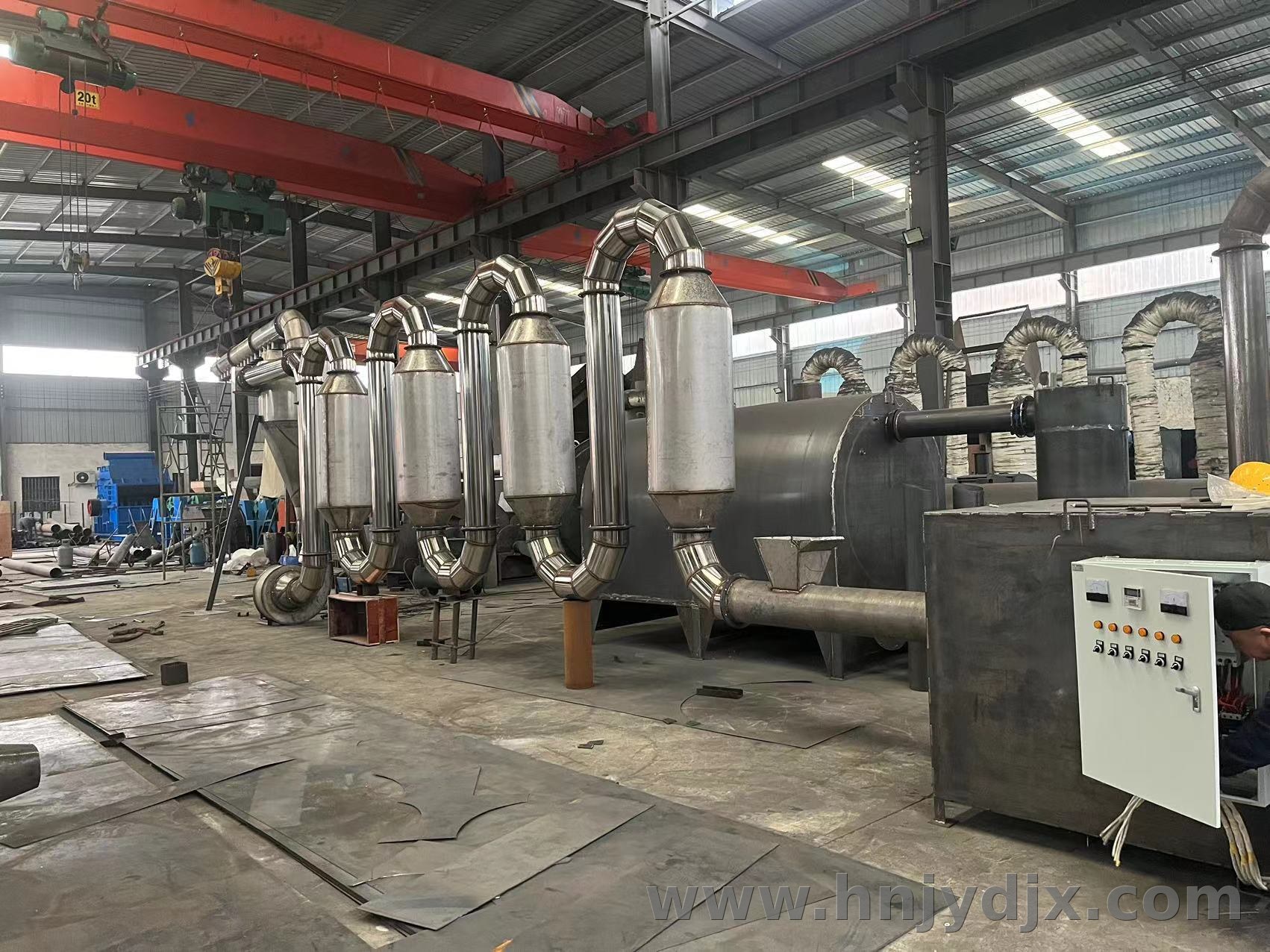
Product Overview
How it works
The core of the flash airflow dryer is the brief contact between high-temperature air and the material inside the drying tube. The material is fed by screw or pneumatic conveyor, mixes with the hot air and releases its moisture within seconds; the vapour leaves with the air into the dust collector.
Tube sizes
The drying tube is available in Φ220, Φ280, Φ325, Φ400, Φ500 and Φ600. A larger diameter carries a correspondingly higher air volume. The model number follows the tube diameter, so JYD-400 refers to a Ø400 mm drying tube.
About capacity figures
Capacity varies with material properties, initial moisture content, target final moisture and hot air temperature, so official figures have to come from a trial run. Air volume is the parameter that can be stated precisely.
Typical applications
The machine is already used for magnesium sulfate, plastic pellets, lithium carbonate and similar materials. See the case studies section for details.
Points to confirm before selection
Material properties, initial moisture content and target final moisture need to be established, together with the available floor space and the electrical or steam supply. A small trial run can settle the parameters if they are not yet clear, before the size is scaled up.
Working Principle
1. Hot air enters tangentially at the base
Hot air enters the drying chamber tangentially from the bottom at a set spouting velocity, creating a rotating upward flow field. The heat source can be a steam heat exchanger, an electric heater, or a gas-fired or coal-fired hot-air furnace; the inlet temperature is set against the material limit and remains adjustable.
2. Wet feed is added continuously and broken up mechanically
Wet material is fed continuously and at a controlled rate into the chamber base by a single or twin screw feeder. The agitator at the base applies shear, blow-float and rotation, so the material is micronised by centrifugal force, shear, impact and friction; larger and wetter agglomerates are broken up mechanically here.
3. Two-phase swirl intensifies heat and mass transfer
In the swirling two-phase flow the solid phase has more inertia than the gas, so the relative velocity between the phases is high and heat and mass transfer are intensified. This is the direct reason for the high production intensity of the machine. Particles that are fine enough and low enough in moisture are carried up by the rotating air stream and dried further on the way; coarse particles stay in the chamber and keep circulating through the disintegrator.
4. The classifier ring sets product size and final moisture
A classifier ring and swirl vanes are fitted in the upper part of the chamber. Only powder that has reached the required particle size and moisture leaves with the air stream; coarse particles are thrown back for further disintegration and drying. Adjusting the classifier ring and the air volume moves product fineness and final moisture within a certain range.
5. Separation and product collection
Product powder and water vapour pass into a cyclone separator followed by a bag filter (two-stage cyclones or wet scrubbing can be supplied to meet local emission limits). Product is discharged continuously by a rotary valve and the exhaust air leaves through the induced-draught fan. The whole system runs under negative pressure, which keeps dust escape low.
6. Why heat-sensitive materials survive
Residence time in the chamber is measured in seconds. During the constant-rate drying period the surface temperature of the material stays close to the wet-bulb temperature of the hot air and therefore well below the inlet temperature: surface moisture is gone before the particle itself can heat up. That is the main reason heat-sensitive, discolouring or decomposing materials are routed this way.
Wet feed caking into lumps is normal for this kind of material, which is why the drying chamber carries a disintegrator at its base: a variable-speed agitator tears filter cake, paste and agglomerates apart before the material meets the main air stream. Caking feed handled is not a slogan here — only after the lumps are broken up does every particle get a chance to be wrapped in hot air. Two machines with the same nominal output can differ noticeably once the disintegration step is done well or badly.
Key Features
- Drying tube available in Φ220 / Φ280 / Φ325 / Φ400 / Φ500 / Φ600
- Airflow drying: hot air contacts the material directly for high dewatering efficiency
- Suits powdery, granular and flake materials
- Compact structure with a small footprint
- Supports steam, electric heating and natural gas heat sources
- Few rotating parts, a simple structure and straightforward maintenance
- Besides the multiple standard tube sizes, the drying tube can be sized to suit the duty
- Drying, disintegration and classification are all done inside one machine, so a separate disintegrator is usually not needed afterwards
- Residence time is measured in seconds, so heat-sensitive material is less likely to discolour, decompose or lose activity
- A disintegrating and distributing device sits at the bottom, so filter cake, paste and caking material can be fed directly
- The classification rings at the top are adjustable, so particle size and final moisture are set to the requirement
- A cooling device sits at the bottom of the drying chamber, which keeps the material from deteriorating in the hot zone
- Pneumatic sealing working with bearing cooling gives the drive section a longer service life
- The system runs under negative pressure, so there is less dust escaping to the atmosphere
- Parts in contact with the material can be specified in 201 / 304 / 316L / 430 / 2205 stainless steel according to corrosiveness
Target Users
- Continuous drying of powdery, granular and flake materials in the chemical, pharmaceutical, feed, food and inorganic substance industries
- Heat-sensitive duties that must be dried within a short time
- Filter cake and paste feeds that need mechanical disintegration before drying
- Production lines with limited floor space that need a compact machine
- New processes to be validated on a small unit (Φ220) before scaling to Φ280 / Φ325 / Φ400 / Φ500 / Φ600
Advantages
- Drying, disintegration and classification in one unit, so a separate disintegrator is usually unnecessary
- Residence time in seconds, so heat-sensitive material rarely discolours, decomposes or loses activity
- Ducting can fold and turn; compact structure with a small footprint
- Few rotating parts and straightforward maintenance
- Drying tube in Φ220 / Φ280 / Φ325 / Φ400 / Φ500 / Φ600, scalable to suit the duty
Limitations and Notes
- Cannot dry materials with very high moisture directly; prior mechanical dewatering is required
- Throughput ceiling is below that of a rotary dryer, so it is not the choice for very large continuous output
Available Heat Sources
Jinyida dryers support flexible heat sources: gas, coal, electricity, steam, electromagnetic, biomass pellets, biomass oil, natural gas and waste wood. The right source is matched to the material and site utilities; the final selection is confirmed in the proposal.
Suitable Materials
Materials above come from our material library and are examples only. Whether a material dries steadily depends on particle size, bulk density and moisture levels; the final answer comes from a trial run with your own material.
Related FAQs
How is dryer capacity stated?
A few points need to be clear about capacity figures:
1. Capacity is not a fixed value. The same machine will produce different figures for a different material, a different initial moisture content or a different target final moisture.
2. Figures must state whether they are on a dry basis or a wet basis. Dry basis means the mass of bone-dry material; wet basis includes the moisture. The two differ substantially and the ambiguity causes problems if it is not stated.
3. Official data comes from a trial run. Until the operating parameters are fixed, any capacity figure is only an order of magnitude.
4. Air volume can be stated precisely. It is fixed by the machine size, does not change with the material and can be given at the selection stage.
Providing the material name, the initial moisture content and the target final moisture is what makes a recommendation usable.
Flash airflow dryer or rotary dryer: which one?
The two have different structures and suit different duties:
Flash airflow dryer
It dewaters through brief contact between high-temperature air and the material. Drying is fast, which suits inorganic salts and chemical powders that need rapid dewatering. Sizes are Φ220, Φ280, Φ325, Φ400, Φ500 and Φ600.
Rotary dryer
The rotating drum tumbles the material for more even heating. It suits sawdust, plastic pellets and flake materials that do not break up while tumbling.
How to decide
Look at the material form and whether it is sticky. Powders and fast-dewatering duties point to flash airflow; granular or flake materials needing even heating point to rotary. The moisture content and target final moisture still have to be considered.
Can the equipment be customised, and what is the lead time?
Equipment is built to suit the operating conditions. Lead time depends mainly on the machine size and how complex the configuration is, and scheduling is arranged once the requirement is clear.
The parameters to provide in advance are: material name and properties, initial moisture content, target final moisture, daily throughput, and the available space and energy supply (electrical capacity or steam parameters).
The clearer the parameters, the more accurate the selection and quotation, and the easier the schedule. If they are not yet clear, a small trial run is the usual way to establish them.