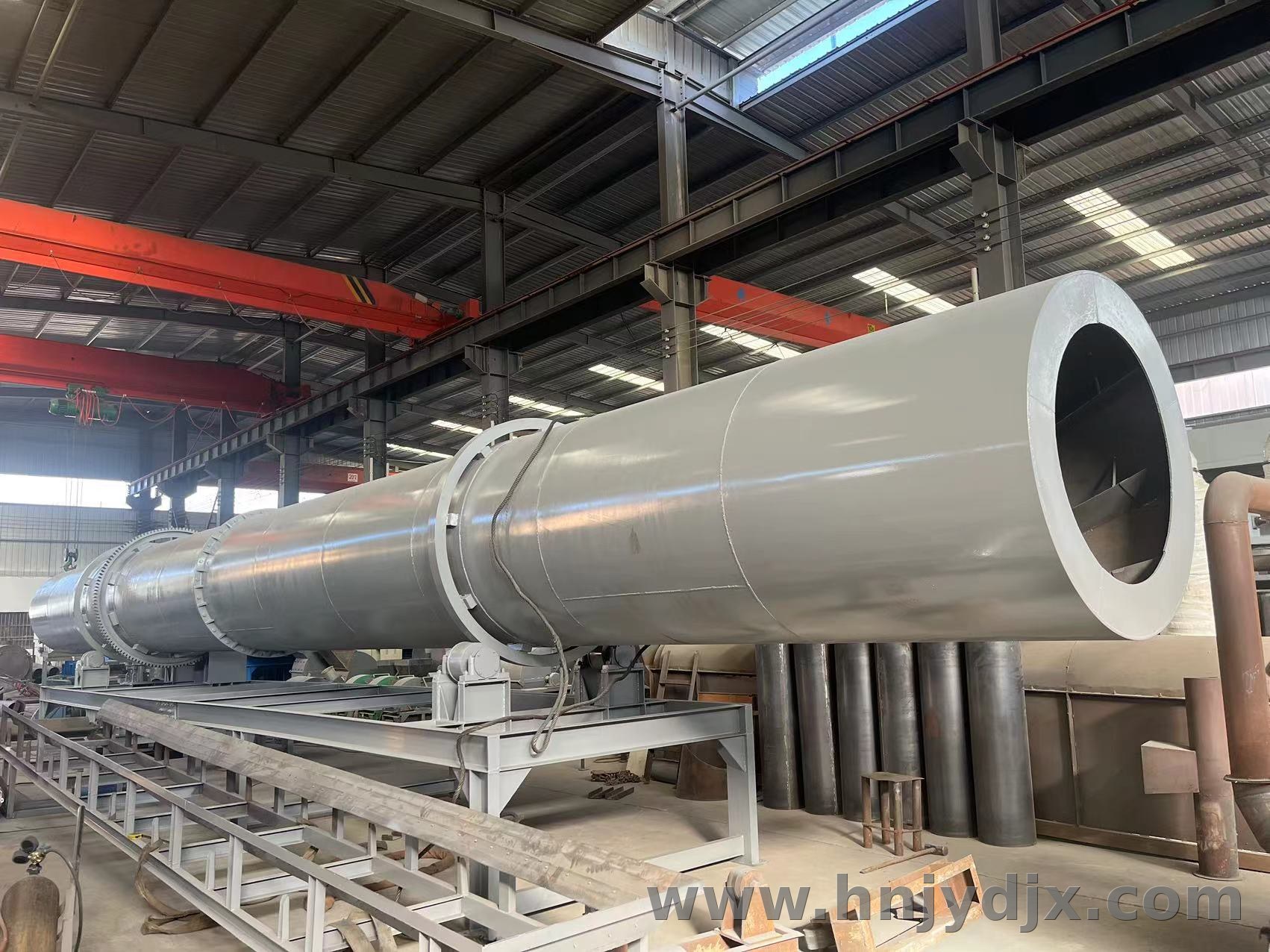
Product Overview
How it works
A motor rotates the drum. Lifters carry the material up and drop it repeatedly so that it contacts the passing hot air and releases moisture. The tumbling motion makes the heating more even.
Model naming
Common model numbers combine diameter and length: 0890 means φ0.8 × 9 m and 1012 means φ1.0 × 12 m.
Suitable materials
Suits sawdust, plastic pellets and flake materials that do not break up while tumbling. For sticky materials the lifter design needs to be adjusted.
Material of construction
Carbon steel is sufficient for ordinary materials; stainless steel is recommended for corrosive ones.
Working Principle
1. The rotating drum tumbles the material
The drum is driven slowly by a motor through a girth gear or riding rollers. Flights on the inner wall lift the material and drop it again, forming a continuous curtain across the drum that meets the hot air passing through.
2. Hot air in co-current or counter-current flow
Hot air can pass through the drum either co-currently or counter-currently. In co-current flow the temperature difference at the inlet is large and drying is fast, which suits high-moisture material that is not very heat-sensitive; in counter-current flow the driving force is distributed more evenly, which suits material that must reach a low final moisture. Which one to use depends on how much discharge temperature the material can take.
3. Residence time is set by speed, inclination and flights together
Residence time in the drum is measured in minutes and is set jointly by drum speed, installed inclination, flight pattern and air volume. When a longer dry is needed, the usual levers are lower speed, less inclination or a different flight pattern — not simply a higher air temperature.
4. Discharge and cooling
Dried material leaves at the discharge end. Where the discharge temperature is high, a cooling section or a separate cooler can be added so that the material does not pick up moisture, cake, or disrupt the next process step while it is stockpiled.
5. Why granular and flaky material suits the drum route
The mechanical action of tumbling is relatively gentle, so granules and flakes are not easily broken and keep their shape and particle size. That is also why powders with a higher bulk density reach a more uniform dry on the drum route. The trade-off is residence time measured in minutes, which is why heat-sensitive material should not take this route.
6. Handling sticky material
Material that turns strongly sticky once wet — bentonite and kaolin are the usual examples — tends to build up on the wall and form lumps. Flight pattern and drum speed then have to be set from the trial run, and where necessary a disintegrator or a recycle mixing step is added at the feed end.
The same nominal specification lands differently on different materials. High feed moisture and a sticky material call for a different drum speed and flight pattern; a site with electricity but no steam means the whole heat-source section is replaced; insufficient headroom forces the ducting to be re-routed. That is what engineered to the material means in practice — the catalogue figure is only the starting point, and structure, material of construction and configuration are then set by the material, the feed and discharge moisture, the building and the heat source. We do not sell one machine for every duty.
Batch charging and a continuous line are two different ways of working. The first costs less to install and switches products easily; the second runs from feed to discharge without interruption, so labour shifts from standing at the machine to watching it run, and the labour and energy per tonne fall as output rises. Which one fits depends on the order pattern, not on which sounds more advanced.
Key Features
- Rotating drum keeps the material evenly heated
- Model naming: 0890 = φ0.8 × 9 m, 1012 = φ1.0 × 12 m
- Stainless steel option for corrosive materials
- Suits sawdust, plastic pellets and similar materials
Target Users
- Plants handling sawdust, plastic pellets, slag, coal mud and other granular, lumpy or flake materials
- High-throughput lines that need long continuous running
- Works with steam, natural gas or biomass heat sources on site
- Dense powders that need drum tumbling to dry evenly
- Users who accept higher initial investment for long-term stable capacity
Advantages
- The rotating drum heats the material evenly, with high single-unit throughput
- Models from φ0.8×8 to φ2.2×27, a full range
- Carbon steel or 201 / 304 stainless steel for corrosive materials
- Flexible heat sources: steam / natural gas / biomass / electricity
- Granular and flake material keeps its form and particle size through tumbling
Limitations and Notes
- Higher initial investment than the other three machine types
- Residence time in minutes, so heat-sensitive materials are not suited to this route
Available Heat Sources
Jinyida dryers support flexible heat sources: gas, coal, electricity, steam, electromagnetic, biomass pellets, biomass oil, natural gas and waste wood. The right source is matched to the material and site utilities; the final selection is confirmed in the proposal.
Suitable Materials
Materials above come from our material library and are examples only. Whether a material dries steadily depends on particle size, bulk density and moisture levels; the final answer comes from a trial run with your own material.
Related FAQs
Flash airflow dryer or rotary dryer: which one?
The two have different structures and suit different duties:
Flash airflow dryer
It dewaters through brief contact between high-temperature air and the material. Drying is fast, which suits inorganic salts and chemical powders that need rapid dewatering. Sizes are Φ220, Φ280, Φ325, Φ400, Φ500 and Φ600.
Rotary dryer
The rotating drum tumbles the material for more even heating. It suits sawdust, plastic pellets and flake materials that do not break up while tumbling.
How to decide
Look at the material form and whether it is sticky. Powders and fast-dewatering duties point to flash airflow; granular or flake materials needing even heating point to rotary. The moisture content and target final moisture still have to be considered.
How is dryer capacity stated?
A few points need to be clear about capacity figures:
1. Capacity is not a fixed value. The same machine will produce different figures for a different material, a different initial moisture content or a different target final moisture.
2. Figures must state whether they are on a dry basis or a wet basis. Dry basis means the mass of bone-dry material; wet basis includes the moisture. The two differ substantially and the ambiguity causes problems if it is not stated.
3. Official data comes from a trial run. Until the operating parameters are fixed, any capacity figure is only an order of magnitude.
4. Air volume can be stated precisely. It is fixed by the machine size, does not change with the material and can be given at the selection stage.
Providing the material name, the initial moisture content and the target final moisture is what makes a recommendation usable.
Can the equipment be customised, and what is the lead time?
Equipment is built to suit the operating conditions. Lead time depends mainly on the machine size and how complex the configuration is, and scheduling is arranged once the requirement is clear.
The parameters to provide in advance are: material name and properties, initial moisture content, target final moisture, daily throughput, and the available space and energy supply (electrical capacity or steam parameters).
The clearer the parameters, the more accurate the selection and quotation, and the easier the schedule. If they are not yet clear, a small trial run is the usual way to establish them.